


In a standardised test apparatus with a contents of 20 litre, a small number of tests is performed over a wide range of concentrations (normally from 30 g/m³ to 2000 g/m³) to determine whether or not the dust is explosible.
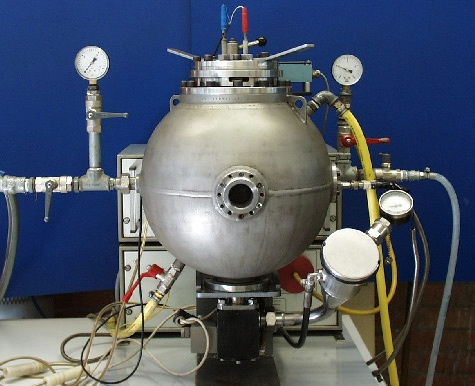
20 litre-sphere
Importance
Before embarking on more specific tests, it is sometimes considered desirable to perform an introductory test in order to determine whether the powder or dust in question can give a dust explosion at all.
Test equipment & procedure
The test is performed in a standardised test apparatus with a contents of 20 litre.
The dust sample is dispersed into the explosion chamber with compressed air from a storage container via a special distribution system. The tests are performed with two pyrotechnic igniters of 1 kJ each as ignition source. The course of the explosion is recorded as a function of time (with two quartz pressure sensors), and from the pressure-time curve the explosion pressure and the rate of pressure rise are recorded.
The explosion behaviour in the 20 litre-sphere is evaluated by means of the explosion pressure. If the corrected explosion pressure exceeds 0.3 bar, an explosion is said to have occurred.
Correction of the measured explosion pressure is necessary to account for the influence of the igniters. Even without an explosive dust in the 20 litre-sphere an important overpressure is recorded, which is caused by the heat liberation from the chemical igniters. The influence of the igniters on the measured explosion pressure diminishes as the pressure effect of the explosion itself becomes larger.
A substance that cannot be detonated over a wide range of concentrations (normally from 30 g/m³ to 2000 g/m³) with an ignition energy of 2 x 1kJ (pyrotechnic detonators) is classified as non-explosive.
The test is normally performed on the fraction of the powder with a particle size < 63 micron.
Remarks
'Not explosible' means that most probably the dust cannot be exploded at all, except by application of even stronger ignition sources (ignition energy > 2 kJ).
Bibliography
- EN ISO/IEC 80079-20-2:2016: Explosive atmospheres Part 20-2: Material characteristics – Test methods for combustible dusts, Section 7.2
- EN 14034: Determination of the explosion properties of dust clouds
- VDI guideline 2263, Sheet 1: Investigation methods for determining the safety-related parameters of dust (1990)
- Kühner AG, Operating instructions for the 20 litre apparatus
- W. Bartknecht, Dust explosions: course of events and protective measures (1987)
- R.K. Eckhoff, Dust explosions in the process industries (1997)
- Explosion protection manual, Kluwer-Editorial